
React now. Remember what matters.
An embodied agent lives in two timescales at once. A moving object demands an immediate response. An instruction may need to survive long after the person who gave it has stopped speaking.
Imagine asking a robot to move a puck to one side of a barrier. You show the destination briefly, then remove the cue. Halfway through the task, you change your mind. A useful model must see the barrier, keep the original destination while it is relevant, replace it with the new destination, and continue controlling the puck without replaying an ever-growing history.
Signal-Latent World Models investigate this problem through a shared internal representation of video, audio, body state, text, and actions. The model predicts how that representation will change under candidate actions. A separate commitment mechanism determines whether the available evidence supports acting, relying on a trusted sensor, probing, or waiting.
The central contribution is a set of architectural separations: fast sensory processing versus persistent memory; symbolic keys versus moving visual context; and current pose versus predicted motion versus remembered goals. The seven-wave study follows these mechanisms from failed early designs to targeted ablations and a later spatial refinement.
A compact state can preserve a changed goal beyond a local attention window. Doing so reliably depends on what is kept separate inside the model—and does not yet solve general spatial reasoning, speech understanding, or real-world robot control.
Discussion & conclusion · §§6–7SLWM-X1B
1,008,454,410 total parameters. The main 1.008B comparison and doubled-exposure results are in Waves 4–5.
SLWM-v2
453,199,938 total parameters. Wave 7 changes the spatial readout without adding parameters to the matched 453M model.
Reading guide: the manuscript has not yet been published. Numerical results below are reported in draft v0.3. The explanatory examples and proposed next steps are this article’s interpretation, not additional experiments.
A short guide to the terminology
- Latent field
- A learned internal representation of observations. It carries features useful for prediction without storing the full input stream.
- Working memory
- State carried between ticks, such as a remembered goal. Updating this state during a mission is different from retraining the model’s weights.
- Proprioception
- Measurements of the agent’s own body or mechanism. In the later unprivileged experiments, these describe the end effector, rather than supplying the object’s location.
- JEPA
- Joint-embedding predictive architecture: learning to predict a representation of a future observation, rather than reconstructing every future pixel.
- Out of distribution (OOD)
- A test condition that differs from training, such as a longer episode, a new obstacle layout, or an unseen camera corruption. Each difference tests a specific kind of generalization.
- AUROC
- A threshold-independent measure of how well a score separates two classes. Here it measures separation of corrupted and clean camera inputs; a usable operating threshold still has to be chosen.
One world field. Different jobs.
Every 100 ms tick begins with a collection of signals. Instead of collapsing everything into a single vector, the original X1B architecture lays out 24 typed slots. Keeping their roles explicit helps preserve spatial structure and gives persistent memory a place of its own.
Keep current perception fast
A long stack of smoothing filters can make a model react to where an object was. The sensory bypass sends most of the current signal directly onward, while memory registers retain a stronger historical component. This lets immediate geometry and longer-term context use different timescales.
The core interleaves three gated-delta recurrence blocks with one local-attention block. At 1.008B, 23 layers include five attention blocks with an eight-tick ring buffer. “Zero-lag” names the sensory bypass design; it is not a claim of zero inference latency.
Give memory a stable address
To replace “go to A” with “go to B,” memory needs to find the same instruction binding again. If moving visual patches alter the symbolic key, the new write can miss the old entry. Directed key shielding prevents visual changes from entering the text slot, while allowing embodied slots to read the text.
The gated-delta matrix update adjusts an addressed association rather than simply fading the whole past. A useful analogy is editing one entry in a notebook while keeping the others. It remains learned, finite-capacity memory: the analogy does not imply perfect symbolic storage.
The memory update, unpacked
For one attention head, the recurrent matrix reads from the previous state before applying a new write:
Mt = αtMt−1 + βt(vt − αtMt−1kt)kt⊤
The key k selects an association, the value v supplies its new content, α controls retention, and β controls the update. With a unit key and α ≈ β ≈ 1, the old value along that key is removed before the new one is written. Shielding the text slot helps keep this address stable under visual motion; it does not make every pooled memory operation immune to interference.
Equation 1 · §3.2Separate seeing, forecasting, and remembering
The model uses distinct readouts for current visual pose, predicted physical change, and the remembered goal. These tasks impose different demands: the pose head should follow movement immediately, while the goal head should remain stable when a cue disappears.
An action-conditioned latent predictor learns residual changes over one, two, and four steps against an exponential-moving-average target encoder. Predicting a change has a useful reference point: a zero residual means persistence, or “the state stays as it is.” Anti-collapse regularization discourages the uninformative solution in which every observation maps to the same latent representation.
Make commitment an explicit decision
A forecast is not automatically an action. The commitment gate combines prediction surprise, disagreement between vision and body-state estimates, and sensor availability. In the tested settings, it can route control through trusted proprioception, request a bounded probe, abstain, or wait.
The planner evaluates short candidate action sequences in latent space and executes the first action, then observes again. This repeated replanning is model-predictive control (MPC). It provides a way to use learned predictions while correcting course from fresh observations.
The design builds on Gated DeltaNet recurrence, the 3:1 hybrid schedule studied in Kimi Linear, and action-conditioned EMA-JEPA planning. The paper’s contribution concerns their integration and targeted separation of perception, memory, and control. Prior work & methodology · §3
Preserve where, not just what.
When object coordinates were removed from body-state inputs, averaging the visual slots lost the information needed to locate the object. Wave 7 adds an 8 × 8 spatial readout using existing weight slices, mixed max/mean pooling, and a spatial soft-argmax. A learned hazard grid then supplies subgoals to the planner.
“Zero added parameters” means the refinement reuses the matched 453M model’s weights. It changes the computation and supervision; it does not imply zero additional computational cost. The planner receives no privileged wall coordinates in this setting.
Spatial refinement · §3.5A longer history need not mean a larger cache.
A dense attention model normally stores keys and values for every past tick. Its cache therefore grows with the stream. SLWM combines a fixed recurrent state with a short circular attention buffer, so the retained state stops growing even as the stream continues.
The distinction is state size versus memory quality. A fixed-size state is a compressed summary, not a lossless archive. It can forget, interfere with itself, or fail to preserve the detail a future task needs. Sliding-window attention and diagonal-state models also have bounded state; the experiments ask how effectively these different memories support control and selective overwrite.
A longer stream. The same state.
State per stream in MiB · logarithmic bar scale
The ungrouped dense cache uses 222.2× SLWM’s streaming state at this horizon.
At 1,024 ticks, the original ungrouped dense cache is about 222 times larger than X1B’s 14.91 MiB streaming state. Grouped-query attention narrows that gap to about 27.8 times. DiagonalSSM uses still less state than SLWM. These comparisons concern the stored stream state only: they do not measure total device memory, energy, throughput, or end-to-end planning latency.
The experiment matters as much as the score.
The manuscript reports 171 training and ablation runs across seven waves and model sizes of approximately 152M, 453M, and 1.008B parameters. Later waves change training exposure, available observations, spatial supervision, and evaluation difficulty. Their scores should be read within those settings.
More training exposure strengthens control
Doubling X1B’s exposure from 2,800 to 5,600 steps raises one-pixel-barrier success from 55.6 ± 20.3% to 86.1 ± 5.5%. At the longer 76-tick horizon, it reaches 100% in the evaluated sustained-goal and goal-switch missions. All four 1.008B cohorts below share the same encoders, readouts, objectives, and planner.
| Model at ~1.008B | Overall MPCSuccess % ↑ | 1-px barrierSuccess % ↑ | Goal switchT = 76 · % ↑ | RecallT = 1,024 · % ↑ |
|---|---|---|---|---|
| SLWM-X1B | 80.9 ± 4.2 | 86.1 ± 5.5 | 100.0 ± 0.0 | 81.3 ± 26.5 |
| DiagonalSSM | 86.8 ± 11.0 | 75.0 ± 22.9 | 93.8 ± 2.2 | 37.5 ± 10.2 |
| SlidingWindow-W64 | 67.7 ± 15.9 | 35.4 ± 31.8 | 76.6 ± 4.4 | 4.2 ± 5.9 |
| DenseTransformer | 70.8 ± 18.5 | 41.7 ± 36.9 | 40.6 ± 35.1 | 43.8 ± 5.1 |
Table 5, 1.008B cohorts only. Wave 5 still supplies object coordinates in proprioception and uses a central-barrier planning prior. DiagonalSSM has the higher mean overall MPC score, so this is not uniform SLWM dominance. Original Table 5
Removing one mechanism explains what it contributes
Symbolic-key shielding
Removing only the shield changes dynamic-visual overwrite recall at T = 1,024 from 100.0 ± 0.0% to 43.8 ± 51.2%. The large seed variation is part of the result.
Sensory direct feedthrough
Removing the bypass increases scene-disjoint four-step xArm6 error from 32.16 to 37.56 mm, while preserving the reported associative recall. It affects physical tracking and memory differently.
Separate readout heads
Combining the readouts reduces long-horizon recall to 72.9%. Replacing VICReg with Epps-Pulley SIGReg, meanwhile, produces similar outcomes in this study.
These are controlled ablations within the tested architecture, not universal claims about all recurrent or attention models. Table 6 · §5.6
A harder test of memory and spatial grounding
SLWM-v2 removes privileged object and obstacle coordinates, retains end-effector proprioception, and derives spatial subgoals from vision. Its most revealing memory test changes the goal early, fills the intervening stream with distractors, then physically resets the puck after the new cue has passed beyond the comparison model’s attention window.
Remembering a new goal beyond the attention window
At T = 160, the model must recover the latest goal after a physical reset, 69 ticks after the cue disappears. The sliding-window baseline directly attends to only the last 64 ticks.
SLWM-v2 has a clear advantage over the two bounded-state baselines here. The unshielded variant is close: this small-goal task alone does not establish the need for key shielding.
Four-step error on trajectory-disjoint physical xArm6 recordings. Train and test share camera/workspace geometry.
Four-step error on the locked two-scene evaluation split. A harder generalization setting at 453M.
Both robot results are offline predictions on recorded physical trajectories, not live closed-loop hardware experiments. Values follow the detailed cohort assignments in Tables 5 and 7 and §§5.5–5.7. Robot-transfer figures
How to read the uncertainty and comparisons
Unless stated otherwise, “±” is the standard deviation across three training seeds. It is not a confidence interval. The manuscript also reports paired episode-level and hierarchical seed-cluster bootstrap intervals; the latter resample both seeds and episodes.
Thousands of episodes do not replace many independent training seeds. With n = 3, seed-level uncertainty remains substantial. The reported phier is the fraction of bootstrap resamples with a positive effect, not a conventional hypothesis-test p-value.
Parameter accounting includes adapters, the processor, prediction heads, policy heads, and readouts. Near-matched baseline sizes are disclosed in Table 1. An architectural comparison controls these ingredients within a wave; comparisons between waves also reflect changed exposure and supervision.
Experimental setup & statistical protocol · §4Watch the instruction become memory.
Scrub through an original Wave 4 trajectory or play it at the study’s 100 ms tick interval. Switch the model to compare the same mission. The small cross marks the decoded goal in memory: after a cue disappears, the model must use that internal estimate to continue.
Loading the recorded trajectory…
The replay is an illustrative, archived seed-2001 study example. It predates Wave 5’s doubled exposure and Wave 7’s spatial-grid evaluation; its final outcome should not be substituted for their reported aggregate results.
The failures are part of the result.
The strongest conclusion is architectural: memory, sensory tracking, and planning benefit from different computational paths. The evidence does not establish a universally superior backbone or a ready-to-deploy general-purpose world model. Several failures are especially informative.
Spatial learning competes with symbolic recall.
Wave 6 achieves 100% dynamic-visual recall at T = 1,024. In Wave 7, dense spatial and hazard supervision accompanies a drop to 6.3% synthetic recall. Exposure also changes from 2,600 to 2,200 steps, so the cross-wave regression does not by itself isolate a single cause. Strong goal recovery and high-capacity associative recall remain distinct achievements.
A better spatial map does not solve unfamiliar physics.
Under the combined 2.6× puck-mass and near-frictionless dynamics shift, success falls to 6.3% across cohorts. The learned transition, short planning horizon, and shared push primitive still have a narrow operating range.
Spoken instructions remain weakly understood.
Held-out spoken-plus-text discrimination remains roughly 52.6–55.2%, near 50% binary chance. Good action-conditioned tracking does not demonstrate broad language understanding. The stronger single-workspace robot result also does not establish transfer to new scenes.
Detection and bounded state are only pieces of reliability.
High AUROC ranks tested camera faults well; it does not specify a deployment threshold, false-alarm cost, or how safely the agent behaves after detection. Constant streaming state does not establish a real-time latency or energy budget. Physical robot evaluations remain offline.
The seven-wave learning process
An initial 24-slot field exposes symmetric planner cancellation and loss of radial distance during normalization.
Sharper planning improves control, while a deep recurrent stack reveals sensory delay and drifting symbolic keys.
A sensory bypass and text shield restore key mechanisms, but shared readout heads interfere with transient-goal control.
Separate heads, unrolled latent prediction, and three-seed comparisons establish the main 1.008B study.
More sequence exposure, bounded-state baselines, and recorded xArm6 trajectories clarify the scaling result.
Single-factor removals isolate mechanisms. Removing privileged coordinates reveals the global-pooling bottleneck.
A parameter-neutral spatial grid improves visual grounding and exposes the remaining multi-task recall trade-off.
Counts follow the manuscript’s reported run ledger. These waves are an iterative research history, not a single fixed benchmark in which every successive score is directly comparable.
Where this could lead—and what must come first.
The architecture is promising for systems that must stay attentive over long streams while remembering instructions that are no longer visible: assistive robots, persistent sensing, and interactive agents. Its practical value would come from retaining the right information, revising it cleanly, and knowing when the current sensors are insufficient.
These are potential applications, not demonstrated capabilities. The next work should test the remaining bottlenecks together, with simple baselines and explicit decision criteria.
Make spatial grounding and rich recall coexist
Vary loss balance, training exposure, and write/read routing under matched budgets. Track visual pose, hazard prediction, long-horizon recall, and embodied goal recovery in the same checkpoint.
Progress would mean: a joint improvement without sacrificing one capability to obtain another.
Test memory on more varied instructions
Use randomized goal content, more possible goals, repeated overwrites, and distractors. Compare with an explicit last-command memory so task structure cannot stand in for understanding.
Progress would mean: successful control depends on the actual instruction and survives several replacements.
Generalize the physics and language grounding
Evaluate new geometry, camera views, object properties, and dynamics separately. Test richer speech or vision-language encoders with their pretraining and parameter costs reported, alongside the current from-scratch controls.
Progress would mean: useful instruction-conditioned behavior on held-out scenes, speakers, and physical conditions.
Close the loop on physical hardware
Measure live perception-to-action latency, full memory use, false alarms, recovery, and actual task success under bounded operating conditions. Replicate across more seeds and compare strong matched planners and recurrent baselines.
Progress would mean: the offline forecasting advantage translates into measured closed-loop benefit.
The promising idea is selective persistence: keep perception responsive, preserve instructions long enough to matter, and make replacement explicit. The next milestone is to make those properties coexist with stronger spatial and language grounding in one model.
Open the evidence.
The original, unpublished manuscript draft is preserved unchanged. Explore its figure panels below, download the reported-value tables, or inspect the pinned source snapshot behind the recorded replay. The companion pack brings the draft, original panels, replay trace, table transcription, citation, and checksums together.
Shared open research artifacts from work at valuealigned.ai and keplen.ai.
Manuscript draft
Unpublished · v0.3 · November 14, 2026
21 pages · PDF
Research companion pack
PDF + 12 figure panels + replay
CSV, BibTeX & provenance · ZIP
Reported results
Selected values from Tables 1, 5–7
Manuscript transcription · CSV
Inference & model manifest
Pinned Wave 4 documentation
Checkpoint metadata & usage
Reference checkpoints for the manuscript
These checkpoints accompany the unpublished manuscript draft v0.3. They are shared for reference and reproducibility of the study, not as formal model releases. Each repository includes BF16 and INT8 weights, its original run records, loading instructions, and checksums under the MIT license.
1.008B parameters · Wave 5 · seed 2001
Reference checkpoint for the study with doubled training exposure, editable working memory, and action-conditioned prediction.
453M parameters · Wave 6 · seed 2001
Full-model reference for the memory and single-factor ablation study; preserves the documented spatial-pooling limitations.
453M parameters · Wave 7 · seed 2001
Spatial-refinement reference for visual planning and beyond-window goal switching, including the reported associative-recall trade-off.
Each artifact is the fixed seed-2001 reference from its own wave. Its recorded metrics are single-seed values, distinct from the manuscript’s three-seed summaries. Run examples and validation checks · Artifact index and verification records · valueai-org
 View full resolution
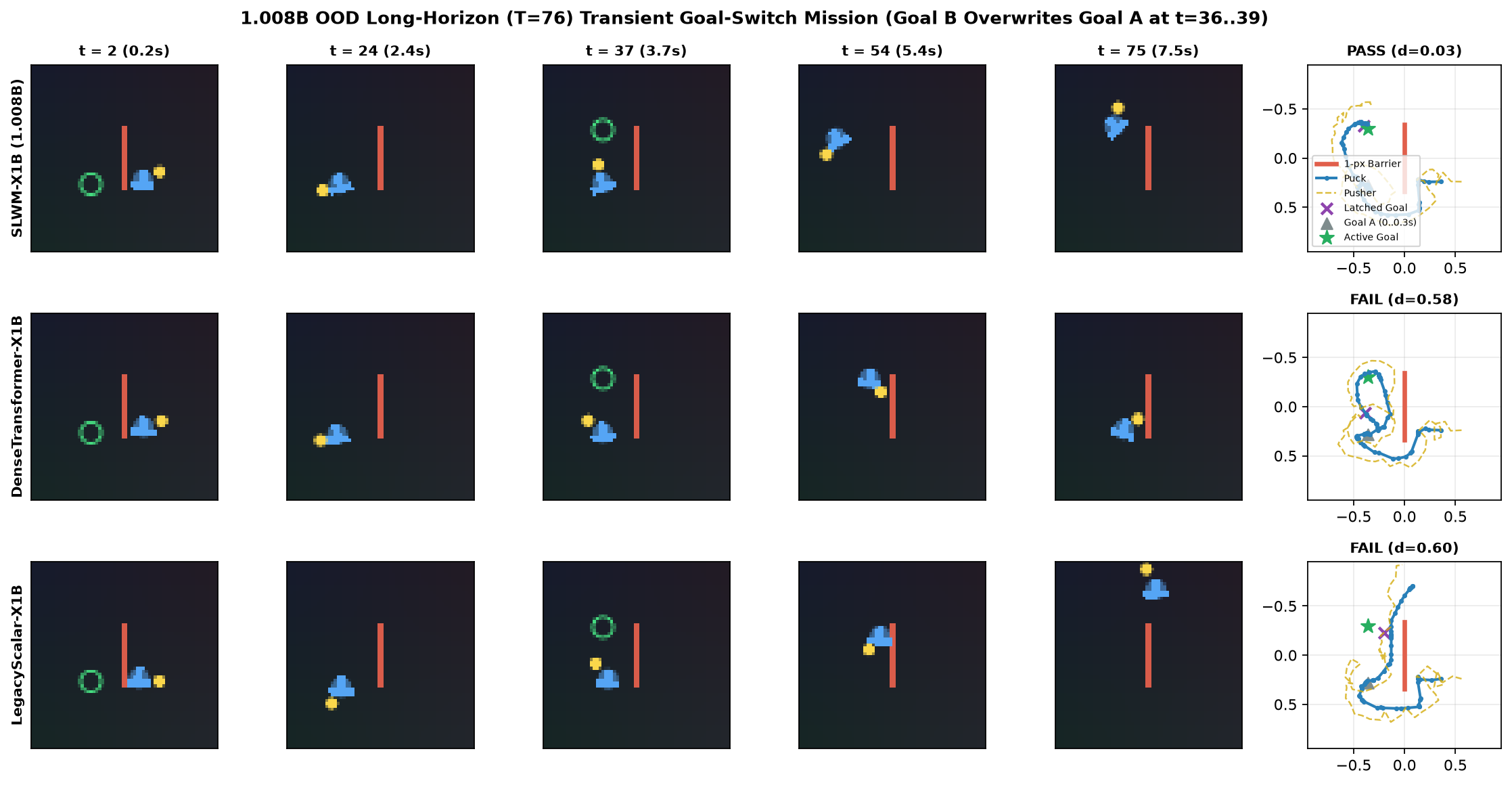
A goal changes mid-mission
Wave 4, seed 2001: a 76-tick recorded mission. Goal B replaces Goal A at ticks 36–39. The SLWM example finishes near Goal B; the two baseline examples do not. This is one illustrated run, not the aggregate success rate.
Trace the implementation
01Shared open SLWM code and research artifacts published through valuealigned.ai.
Experiment definitions in the inspected Wave 4 source snapshot.
Architecture variants and run configuration.
Evaluation code; the planner is in evals/x1b_mpc.py alongside it.
The pinned Wave 4 report, per-run records, figures, and replay examples.
Provenance: repository links are pinned to db14b63, the inspected Wave 4 source snapshot. The v0.3 PDF and its accompanying figures are the source for Waves 5–7 here. The CSV contains reported summary values, not raw measurements. Model weights are hosted separately on Hugging Face; the companion pack does not contain them or the complete seven-wave training archive. View file checksums and source mapping
The manuscript, in full.
Antunes, D. (2026). Signal-Latent World Models at 1.008B Scale: Separating Fast Sensory Grounding from Editable Working Memory Under O(1) Streaming Control. Unpublished manuscript, draft v0.3, dated November 14, 2026.
@unpublished{antunes2026slwm,
  author = {Antunes, Diogo},
  title = {Signal-Latent World Models at 1.008B Scale:
           Separating Fast Sensory Grounding from Editable
           Working Memory Under {O}(1) Streaming Control},
  year = {2026},
  month = nov,
  note = {Unpublished manuscript, draft version 0.3, dated November 14, 2026},
  url = {https://diogoantunes.ai/media/publications/slwm_x1b_paper_v03.pdf}
}